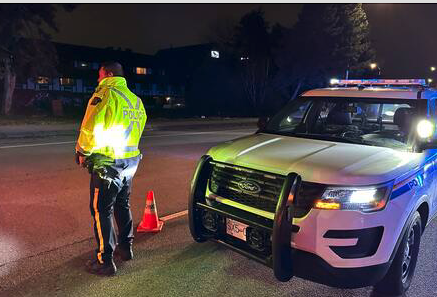
Richmond RCMP officer standing roadside. (Courtesy BC RCMP)
April road safety campaign focuses on yielding laws and driver responsibilities to keep Richmond roads and workers safe.
This April, Richmond RCMP is joining ICBC in educating the public on their legal obligations when vehicles are stopped alongside the road that have flashing red, blue, or yellow lights. This includes emergency vehicles such as police, fire, and ambulance, as well as maintenance workers, including tow trucks, Commercial Vehicle Safety Enforcement vehicles, animal control, garbage collectors, and other roadside workers and personnel.
Slowing down, moving over, and yielding provides first responders and roadside personnel with greater protection from collision and injury.
Failure to yield can result in a fine of $173 and 3 demerit points under British Columbia law. Offences and infractions that include penalty points can lead to a driving prohibition.
What drivers are required to do:
- Slow down and move over: When passing a stopped vehicle with flashing lights, motorists must reduce speed to 70 km/h if the posted speed limit is 80 km/h or higher, or to 40 km/h if the posted speed limit is less than 80 km/h. If travelling on a multi-lane road, drivers must move into another lane to pass stopped vehicles with a flashing light where it is safe to do so.
- Clear a path: Drivers must create a clear path for approaching and oncoming emergency vehicles by moving to the right side of the road and stopping where safe to do so.
- Signal intent: Drivers should use their turn signal to indicate they are pulling over, alerting the emergency vehicle operator to their intention.
- Proceed with caution: Once an emergency vehicle has passed, drivers should remain alert to any additional emergency vehicles before re-entering traffic.
Richmond RCMP Road Safety Unit (RSU) will be monitoring compliance with these requirements throughout the month as part of the provincial enforcement campaign.
For more information on applicable laws and the Slow Down, Move Over campaign, visit the Government of British Columbia website.